Investment Growth: US Leadership and
Benefits for the Global Economy
A Proposal for the United States
1. New Foundations for Global Growth
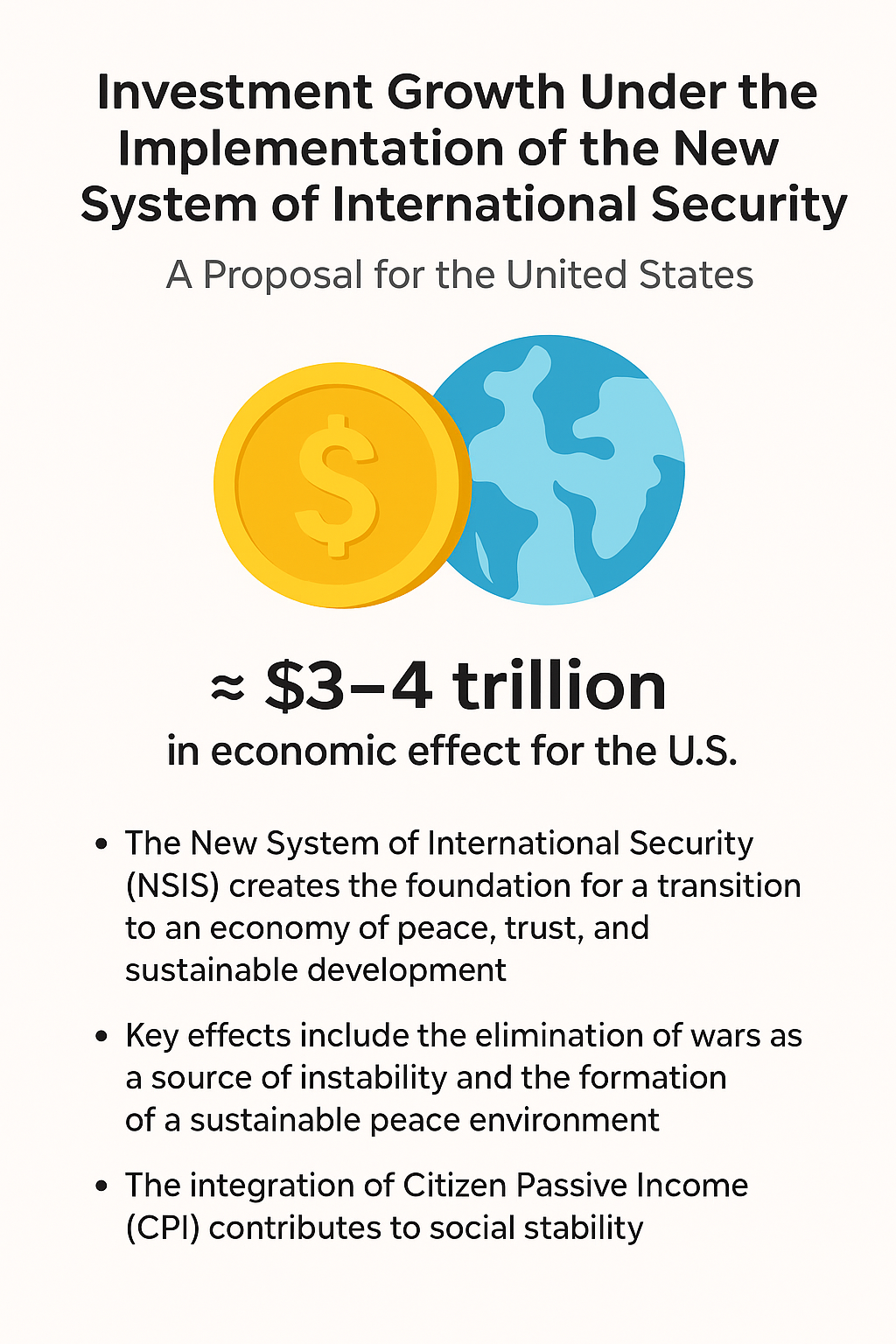
The New System of International Security (NSIS), built on institutional digital polycentrism and ethical algorithmic governance, forms the basis for a transition to an economy of peace, trust, and sustainable development.
- elimination of wars as a source of instability;
- formation of a sustainable peace environment;
- restoration of international investment trust;
- integration of the Citizen Passive Income (CPI) as a foundation of social stability.
2. The Peace Effect and Resource Reallocation
Today, more than 7% of global GDP is spent on military expenditures. Redirecting even half of these resources to development enables 3–5 trillion USD of investment growth in the first five years.
- a new wave of long-term investment;
- return of capital from risky zones into the legal economy;
- activation of the global development multiplier.
CPI becomes an instrument for redistributing digital value, supporting demand, and stabilizing investment cycles.
3. Citizen Passive Income (CPI)
Key numbers:
- global digital revenue: ≈ $11 trillion/year;
- world population: ≈ 8 billion;
- potential CPI: ≈ $1,375/year (~$115/month) per person.
CPI stimulates demand, increases global liquidity, reduces inequality, and adds +2–7% growth to the global economy.
4. Digital Institutions — The Drivers of a Trust Economy
Digital polycentric institutions (DPIs) within the Digital Institutional Platform (DIP) ensure:
- minimal transaction costs;
- transparent property rights;
- automated CPI distribution;
- access to financing, education, and technology;
- accelerated innovation cycles through ethical AI.
Low-risk economy = high investment flows.
5. Climate Adaptation as a New Investment Opportunity
NSIS replaces the “economy of disaster liquidation” with a system of predictable climate adaptation:
- real-time carbon-cycle accounting;
- transparent distribution of green investments;
- global ecological responsibility of digital citizens;
- CPI funding partially sourced from climate revenues.
By 2040, climate investment markets exceed $10 trillion.
6. Combined Economic and Investment Effect
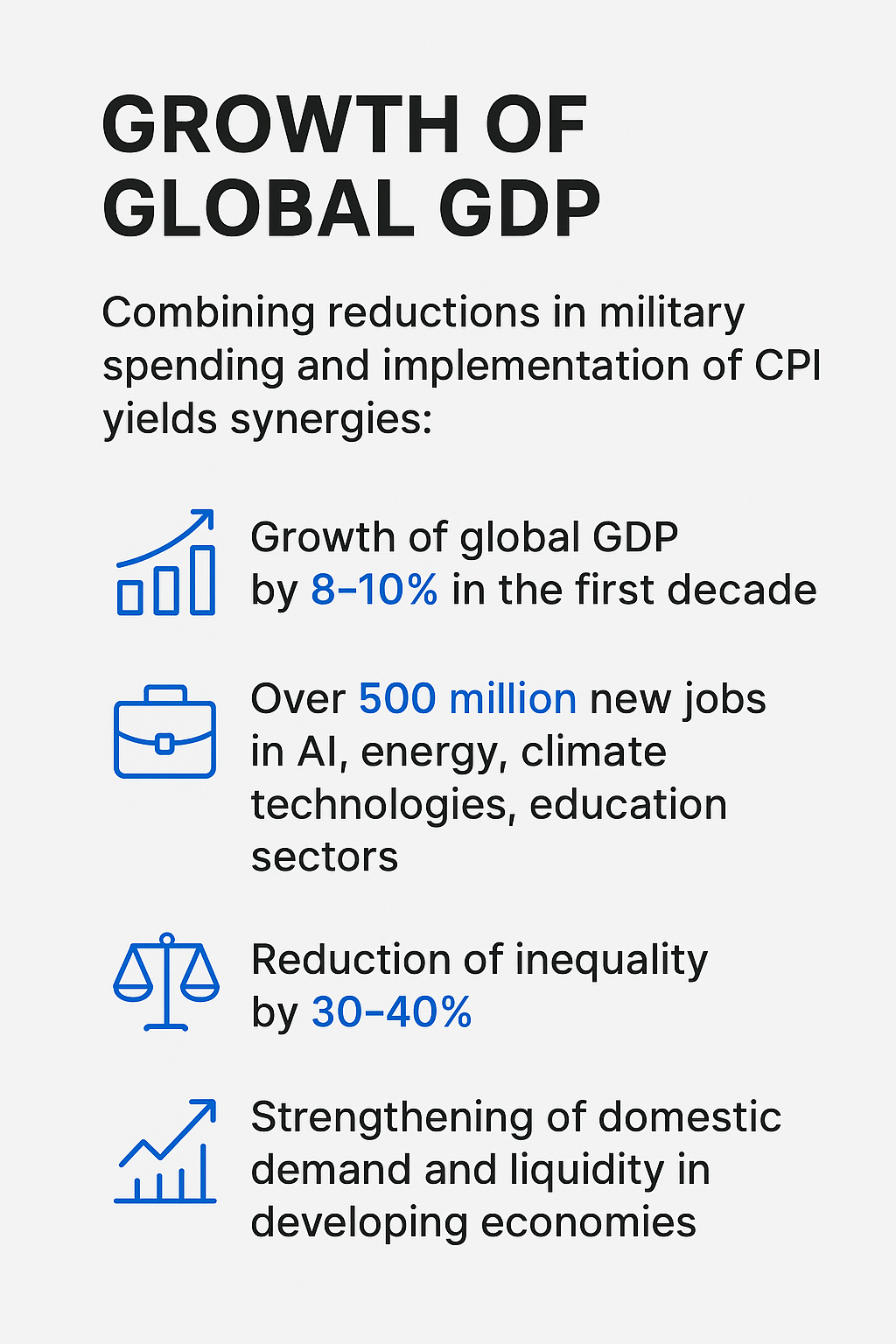
The combination of reduced military spending, CPI, digital institutions, and climate adaptation generates:
- +8–10% global investment growth over the first decade;
- 500+ million new jobs (AI, energy, climate tech, education);
- 30–40% reduction in inequality;
- maximum liquidity for developing countries.
7. Conclusion
The world is transitioning from destruction-based economics to an economy of peace, trust, and digital institutionalism. NSIS + CPI + climate adaptation = a global architecture of ethical renewal.
Critical Distinction
$2 trillion in “investment contracts” ≠ systemic investment growth.
Russia’s contracts create dependency, not development.
What NSIS Achieves
1. Institutional Economic Effect
Conservative estimate: ≈ $11 trillion in global investment expansion.
2. Economic Effect for the United States
Considering U.S. technological leadership and the role of the dollar, the U.S. gains **≈ $3–4 trillion** long-term.
3. Strategic Proposition for the U.S.
“≈ $3 trillion in economic benefit for the United States through leadership in the new institutional architecture of security and the digital economy.”
Conclusion
The proposal is not about promises, but about building a system that multiplies value.
Ukraine offers:
- the New System of International Security,
- ≈ $11 trillion global investment growth,
- ≈ $3–4 trillion economic benefit for the U.S.