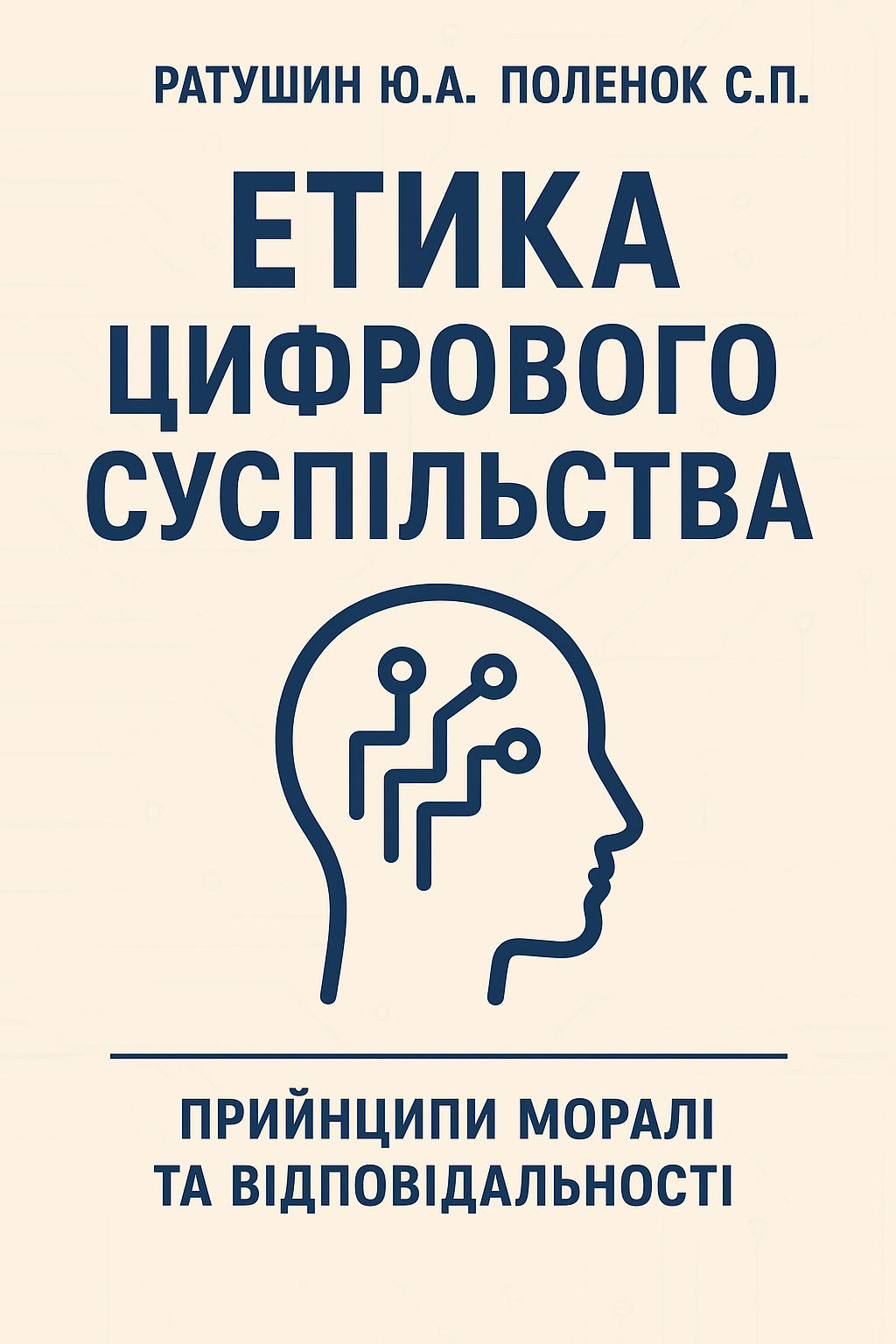
Yurii Ratushyn, Serhii Polenok
ETHICS OF THE DIGITAL SOCIETY
Algorithms of Freedom, Equality, and Justice
Contents
Abstract
Conceptual Overview of the Book
From the Authors
Book Summary
Introduction
· The Mission of the Book: From Ethics to Algorithm, From Morality to Code
· Human Beings, Property, and Values as the Three Ethical Institutions
· From Moral Ethics to Digital Ethics — A New Civilitary Order
· Origins: From the Constitution of the Digital Society to the Digital Institutional Platform (DIP)
· Ukraine as the Ethical Center of the World’s Digital Transformation
Chapter I. The Ethical Architecture of the Digital Society
1. The Digital Society as an Ethical System (Intersystem Dimension), The Antivirus of Populism
2. The Triad of Values: Freedom, Equality, Justice
3. Digital Ethics as the Fundamental Protocol of Trust
4. Algorithmization of Morality: From Choice to Code
5. Human Dignity in the System of Digital Property
Chapter II. Ethical Algorithms of the Digital Institutional Platform (DIP)
1. The Ethical Code of DIP: Institutional Neutrality and Fiscal Justice
2. The Principle of Digital Fiscal Neutrality — The Immunity of the Ethical Economy
3. The Algorithm of Value Distribution: Between Law, Property, and Freedom
4. Ethical Architectonics of Digital Ownership
5. Responsibility and Trust as Foundational Patterns of the DIP
Chapter III. Digital Polycentric Institutions (DPI) as Carriers of the Ethical Code
1. Polycentrism as a Form of Ethical Balance
2. The Ethics of Multipolarity: From Competition to Complementarity
3. From Influence to Resonance
4. DPIs as Neurons of the Ethical Space of the DIP
5. Neuroethics of Polycentric Interaction
6. The Balance of DPIs as a Mechanism to Prevent Digital Totalitarianism
Chapter IV. Ethics of Artificial Intelligence (AI)
1. From the Algorithm of Profit to the Algorithm of Conscience
2. Algorithmic Boundaries of Freedom: When AI’s Decision Becomes Moral
3. Digital Sovereignty of the Person in the Age of Autonomous Systems
4. Neuroethics as a Filter in Human–AI Interaction
5. Ethical Collaboration between AI, DPI, and DIP
6. Responsibility of the Digital Person for AI Actions:
· The Ethical Premise: Human Will in Machine Decisions
· The Principle of Responsible Delegation
· Institutional Responsibility within DPIs
· Digital Legal Personality and the Limits of AI Autonomy
· Ethical Consequence: Restoring Moral Causality
Chapter V. Ethics of Digital Currency
1. Digital Currency as the Ethical Energy of Society
2. The Principle of Fair Value Distribution
3. Citizen Passive Income (CPI) as a Form of Digital Equality
4. Ethics of Circulation, Immunity from Speculation, and Preservation of Dignity
5. Digital Currency as an Instrument of Peace, Not Control
6. Ethical Infrastructure of Digital Stability
7. The Impact of Ethical Digital Currency on National Jurisdictions
Chapter VI. Ethics of Digital Property
1. Property as a Moral Choice in the Digital World
2. Digital Identity and Personal Data: Ethical Inviolability of Ownership
3. Property under the Mode of Shared Responsibility
4. The Algorithm of Ethical Ownership: Right + Responsibility
5. From Fiscal Pressure to Ethical Autonomy
6. The Impact of Digital Property on Global Balance and Sovereignty
Chapter VII. Ethics of Sustainable Development
1. The Interconnection of Ethics, Ecology, and Economy
2. The Ethics of Managing Sustainable Development Projects
3. Ethical Responsibility of States, Corporations, and Communities
4. Projects of the Sustainable Development Hub as Ethical Spaces
5. Tax Immunity as a Form of Ethical Balance
6. Patterns, Replications, and the Algorithm of an Ethical Sustainable Digital Economy (SDE)
Chapter VIII. Ethics of the New System of International Security
1. Morality as the Foundation of Peace
2. From Power Balance to Ethical Equilibrium
3. The Role of DIP in Building Ethical Security
4. Ethical Jurisdiction as an Alternative to Coercive Law
5. Mechanisms for Conflict Prevention through Ethical Algorithmics
6. Strategy for Applying DIP/DPI to End the War in Ukraine
Chapter IX. The Balance of Polycentrism
1. Polycentric Equilibrium as a Form of Peaceful Coexistence
2. From Unipolar Control to Polycentric Ethics
3. Ethical Mechanisms of Self-Regulation in the Global System
4. Polycentrism as the Structure of Justice
5. Ethical Platform of DPIs in the Digital World
Chapter X. Mathematical Models of Ethical Equilibrium
1. Model 1: The Algorithm of Freedom — F = f(S, C, V)
2. Model 2: The Algorithm of Equality — E = f(R, D, A)
3. Model 3: The Algorithm of Justice — J = f(V, L, T)
4. Model 4: Ethical Equilibrium of Polycentrism — P = f(C₁…Cₙ, E, J)
5. Model 5: CPI as a Function of Ethical Balance — U = f(F, E, J)
6. Analytical Commentary: CPI as an Innovative Model of Digital Prosperity
7. Model 6: Fiscal Ethical Neutrality — T_nat = f(D, V_r, P_l)
Chapter XI. The Human Being as the Ethical Center of the Digital Society
1. Personal Sovereignty as an Ethical Norm
2. The Digital Person as an Ethical Subject of DIP
3. The Algorithm of Humanity in the Machine World
4. Digital Spirituality and Civilitary Relations
5. The Human as the Ethical Center of the Digital Civilization
6. The New Humanism of the Digital Age
Conclusion
· The Ethical Symphony of Freedom, Equality, and Justice
· From Ethical Codes to Digital Peace
· Ukraine's Role in Shaping the Global Ethical System
· Ethics as a New Form of Civilizational Contract
Glossary (Definitions)
Appendix: Strategic Action Plan of the Hub "New System of International Security"
Summary
Ethics of the Digital Society
1. What “Digital Society” Means in This Model
“Digital society” is not just about technology. It is a new civilizational paradigm in which digital infrastructure, algorithms, artificial intelligence, and networked institutions form the foundation of social organization.
In this model, traditional forms of organization — centralized states, strict geographic boundaries, vertical hierarchies — give way to polycentric and decentralized institutions, global interaction, and replicated digital structures.
Ethics here is not a “moral option.” Ethics is an operational system of interaction, where freedom, equality, and justice become algorithms themselves.
2. Core Values as Algorithms: Freedom, Equality, Justice
Classical civilizational values are transformed into ethical patterns that function as part of the digital “legal operating system.”
This means that rules of interaction, property rights, and accountability are enforced not only through law or coercion, but also through code, algorithms, and digital institutions.
Ethics becomes systemic: it operates continuously, automatically, and independently of human intervention or selective application.
3. New Distribution of Responsibility: People, Institutions, AI
Questions of responsibility in a digital
world acquire new dimensions.
The answer is polycentric responsibility, where people, digital
institutions, and intelligent agents act within a shared ethical network.
Institutions such as DIP (Digital Institutional Platform) and DPI (Digital Polycentric Institutes) serve as guarantors of: transparency, justice, security, and harmonious interaction between human, machine, and social elements.
In this system, power is not concentrated, and responsibility is distributed.
4. Digital Property, Digital Currency, and Ethical Economy
A new type of economy emerges in a digital society — where data, intellect, algorithms, and digital assets become full-fledged property with legal and ethical significance.
Digital currency and digital property are
not merely instruments of exchange.
They are ethical markers ensuring fair access, equal rights, and
transparent resource allocation.
This forms an ethical economy in which profit and development are governed not only by the market but also by moral principles.
5. Sustainable Development, Global Cooperation, Security
In this system, sustainable development is
impossible without digital ethics:
every environmental, humanitarian, economic, or scientific project is evaluated
for freedom, equality, and justice.
DIP/DPI institutions can coordinate international programs, resource redistribution, climate initiatives, and humanitarian projects without centralized coercion or bureaucracy.
This opens the path to a new global security system, where order relies not on a balance of power but on ethical architecture, trust, and digital integration.
Why This Matters for the USA and Western Audiences — a “Tender for the Future”
We live in a period of radical transformation, where AI and digital systems are reshaping politics, economics, and security. Old models — the nation-state, alliances, power balancing — no longer guarantee stability.
This concept offers an alternative: a civilitarian, ethical, polycentric, and digital model of the world, where:
· human rights
· freedom and justice
· digital rights
· environmental protection
· sustainable development
become parts of a single integrated platform.
For diplomats, investors, strategists, and citizens, it provides an opportunity to envision the future architecture of the world, where human interests, ethics, and technology enhance rather than conflict with each other.
Amid climate risks, technological shifts, growing inequality, and AI challenges, this model offers stability, adaptability, and fair development.